The Murder Castle of H.H. Holmes: The Hotel of Horrors
As you ponder the darker corners of human history, a haunting question echoes through the shadows: What happens when evil is masked by charm and deception? You're about to enter the twisted world of H.H. Holmes, the mastermind behind the infamous Murder Castle, a hotel designed to ensnare unsuspecting victims during the 1893 Chicago World's Fair. With its secret rooms, hidden passages, and cunningly designed traps, this labyrinthine hotel was the perfect playground for Holmes' malevolent games. But what drove this calculating killer, and how many lives did he ultimately claim?
Key Takeaways
- H.H. Holmes, born Herman Webster Mudgett, was a serial killer who operated in Chicago during the late 19th century.
- The Murder Castle was a hotel designed by Holmes to attract victims, featuring a labyrinthine layout with secret rooms and hidden passageways.
- The hotel's design included soundproof rooms, complex hinged walls, and trapdoors to conceal sinister secrets and facilitate undetected movement.
- Historians estimate 27 confessions and around nine confirmed murders, with many victims being young women lured by promises of jobs and charm.
H.H. Holmes' Early Life
As you explore the life of H.H. Holmes, you'll find that his early years were marked by a stark contrast between his exceptional intelligence and his later heinous crimes.

Born Herman Webster Mudgett in 1861, you'll see that he excelled in school and attended medical school, showcasing his intellectual prowess.

However, you'll also discover that he abandoned his first wife and child in 1885, relocating to Illinois and adopting the alias Henry Howard Holmes. This charm and charisma he possessed would later aid him in his deceitful endeavors.

His early life laid the groundwork for his expertise in fraud and deception.
You'll find that his time in medical school and as a pharmacist in Chicago further honed these skills, foreshadowing the horrific crimes he'd eventually commit.
Building the Murder Castle
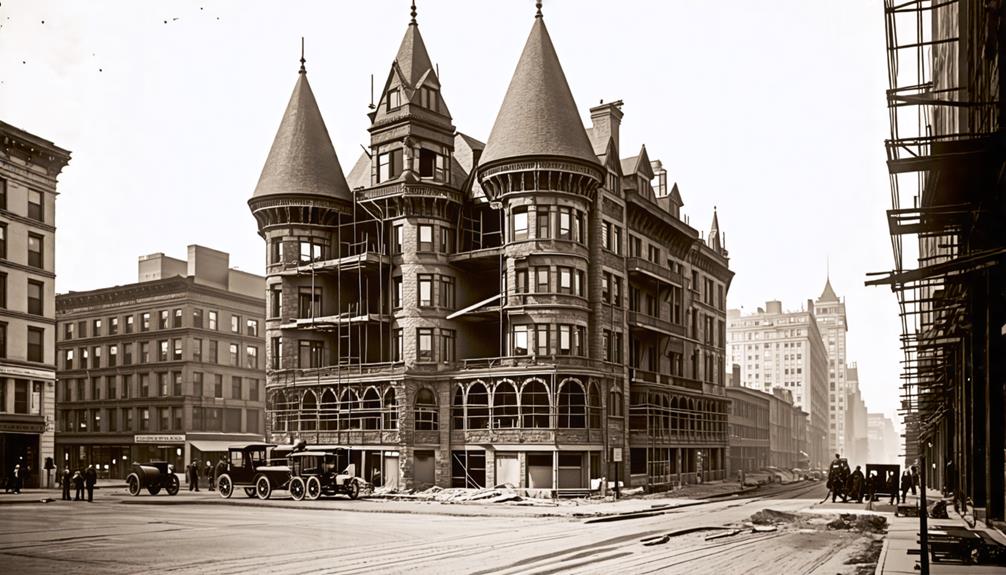
When you examine the construction of H.H. Holmes' infamous Murder Castle, you'll notice that its design seemed ingenious and innocuous, featuring storefronts on the first floor and rental apartments above, all intended to lure in unsuspecting visitors during the 1893 Chicago World's Fair.

However, behind this façade lies a labyrinthine layout, complete with secret rooms, soundproof areas, and hidden passageways, which contributed to its sinister reputation.
You'll find that the construction involved frequent changes in builders, allowing Holmes to implement secretive modifications.

The basement is rumored to contain gruesome tools, although the veracity of these features is debated.
Despite sensationalized claims of trapdoors and gas chambers, experts suggest that the design was primarily for theft and deception, rather than murder.
Secrets of the Hotel
You're now about to explore the infamous 'Murder Castle', but are you prepared to discover the unsettling secrets it hid behind closed doors?
In its complex web of hinged walls and trapdoors, many unsuspecting visitors failed to notice these essential design details.
Look closer at Holmes' infamous abode and you'll stumble upon even more ghastly evidence of 'uncovering hidden passages and secret chambers.'

Uncovering Hidden Passages
The intricate design of the Murder Castle concealed its darkest secrets behind a maze of secret passages, trapdoors, and soundproof rooms, challenging investigators to unravel the truth. As you explore the labyrinthine structure, you'll discover how H.H. Holmes engineered the building to facilitate his heinous crimes. Frequent changes in builders and continuous renovations made it difficult for authorities to understand Holmes' intentions.
| Hidden Features | Purpose |
|---|---|
| Secret passages | Facilitated movement undetected |
| Trapdoors | Provided access to hidden areas |
| Soundproof rooms | Concealed cries for help |
| False walls | Hid dissection tools and crematory |
| Hinged partitions | Created secret chambers |
You'll uncover the shocking truth behind the Murder Castle's design, revealing a complex web of deception and horror.
Gruesome Secret Chambers
Exploring the depths of the Murder Castle reveals a tangled web of secret chambers, each designed to serve a specific, sinister purpose in H.H. Holmes' twisted game of deception and terror.
You'll discover that the labyrinthine layout was intentionally designed to confuse and mislead victims, with numerous hidden compartments, secret rooms, and trapdoors.
The basement allegedly housed gruesome tools for dissection and body disposal, although some claims may have been exaggerated by sensationalist media.
While rumors of gas chambers and elaborate torture methods are likely the result of yellow journalism, it's true that the castle's design allowed for nefarious activities to go unnoticed.
As you navigate the castle's secrets, you'll begin to understand the extent of Holmes' twisted plans.
Deceit and Malice Uncovered
H.H. Holmes's carefully constructed facade crumbled as investigators exposed the sinister secrets hidden within the castle's walls, revealing a shocking web of deceit and malice.
You see, the Murder Castle's design was deliberately deceptive, with soundproof rooms and hidden passages meant to facilitate Holmes's dark activities.
Young women were often lured in with charm and promises of employment, only to mysteriously disappear. Many fell victim to the dark underbelly of society, where exploitation lurked behind the facade of opportunity. The plight of these young women echoes throughout history, reminding us of the struggles faced by women in early Japanese literature, who often navigated a world rife with obstacles and societal expectations. Their stories, woven into the fabric of cultural narratives, serve as a poignant reminder of the resilience required to seek freedom and agency in a tumultuous world.
As investigators dug deeper, they uncovered gruesome tools, a blood-stained operating table, and women's clothing in the basement.
The evidence reinforced the castle's reputation as a site of malice and deceit.
Sensational journalism of the time added to the castle's infamy, but it was clear that Holmes's deliberate design had enabled his brutal crimes.
Victims of the Hotel
Behind the charm and grandeur of Holmes's hotel, a staggering number of people, mostly young women, fell prey to his brutal crimes, leaving behind a trail of unanswered questions and unsolved mysteries.
You find yourself wondering how many victims Holmes actually claimed. Historians estimate that while he confessed to 27 murders, only around nine are confirmed, including Benjamin Pitezel and his two children, who were murdered in an insurance fraud scheme.

As the full extent of Holmes's crimes came to light, a bizarre and disturbing series of events unfolded, affecting those who'd crossed paths with the notorious serial killer.
The aftermath of the murders was marked by a string of strange deaths. The informant who tipped off the police was shot by a Chicago cop, and the warden of Holmes' prison took his own life.
Additionally, the district attorney’s office caught fire, and Patrick Quinlan, the former caretaker of the Murder Castle, died by suicide in 1914, leaving behind a haunting note. The note hinted at a chilling link to historical figures, suggesting a twisted inspiration from count dracula and vlad the impaler. Quinlan’s demise and the destruction of the district attorney’s office shrouded the case in even more mystery, as rumors spread about the unsolved crimes that haunted the Murder Castle. As investigators sifted through the ashes, they couldn’t shake the feeling that the shadows of the past were still very much alive, waiting to reveal their dark secrets.
The Murder Castle itself was destroyed by fire in 1895, and its remains were demolished in 1938.
Today, the site is home to a post office, but the dark legacy of Holmes' crimes continues to captivate and horrify the public.
Trial and Execution
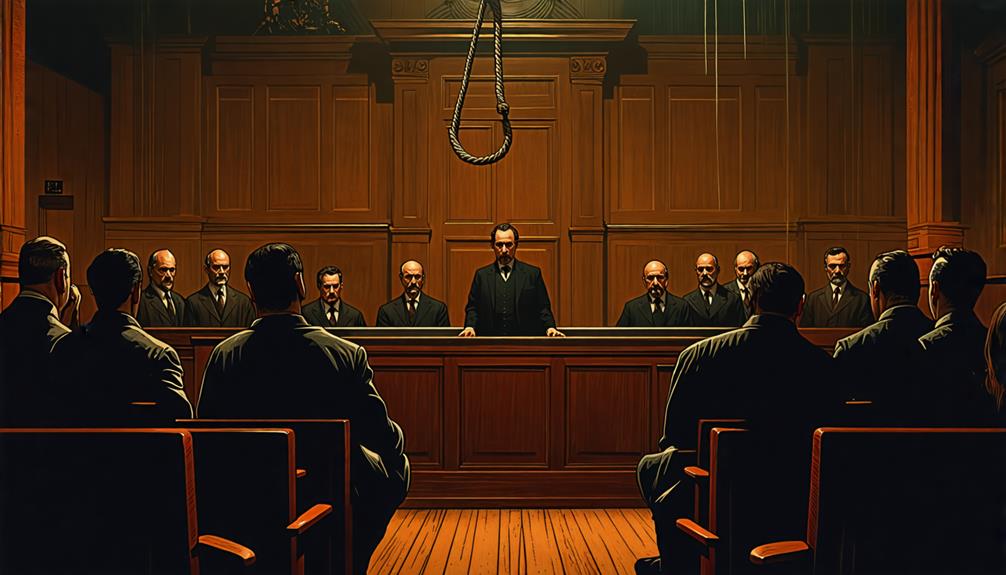
Rarely had a trial captivated the nation like that of the infamous serial killer, who was finally brought to justice in August 1895 for the murder of Benjamin Pitezel.
You see, H.H. Holmes' trial was a culmination of events that began with his arrest in Boston for insurance fraud in November 1894.
As the trial progressed, evidence of Holmes' involvement in the deaths of Pitezel and his children emerged, ultimately leading to his conviction in November 1895.
You might be surprised to know that Holmes was sentenced to death, primarily due to his confession and circumstantial evidence.
His execution by hanging took place on May 7, 1896, shortly before his 35th birthday, bringing an end to the life of the notorious H.H. Holmes.
Legacy of H.H. Holmes
Over a century since his execution, H.H. Holmes' dark legacy as America's first documented serial killer continues to captivate audiences, inspiring a multitude of true crime narratives and cultural representations that explore the twisted depths of his crimes.
You can't help but be drawn into the world of the Murder Castle, where charm and deception led to unimaginable horrors.
Erik Larson's *The Devil in the White City* is just one example of how Holmes' legacy has influenced the true crime genre.
As you investigate the mysteries of the Murder Castle, you'll discover how Holmes' crimes reflect the vulnerabilities of urban life in the late 19th century.
Historical research continues to unravel the complexities of his life, but one thing is certain – H. H. Holmes’ legacy is a haunting reminder of the dangers of unchecked evil. As investigations into his activities reveal a pattern of manipulation and deceit, parallels can be drawn to some of history’s most notorious crimes, such as the heist of the Mona Lisa. Both cases reflect the chilling reality that genius can sometimes masquerade as malevolence, captivating public interest while leaving behind a trail of devastation. Ultimately, Holmes’ story is a cautionary tale that urges us to remain vigilant against the darker impulses that can thrive in society when left unchecked.
Unraveling the Mysteries
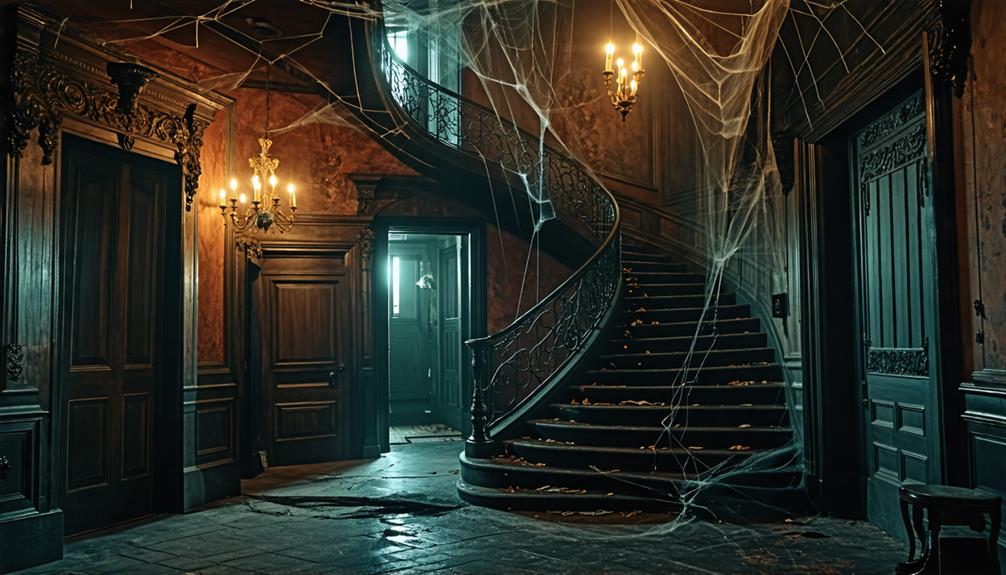
You’re about to explore the labyrinthine world of the Murder Castle, where separating fact from fiction is essential in unraveling the mysteries surrounding H. H. Holmes’ crimes. As you navigate through the twisted corridors and hidden rooms, you’ll discover how the architecture of the Murder Castle itself played a crucial role in Holmes’ sinister operations. Many theories abound regarding his motivations, and one of the most intriguing links involves the shadowy legacy of henry i’s unexpected demise, which some believe set the stage for Holmes’ own dark ambitions. Each detail you uncover pulls you deeper into the chilling narrative of a man who embodied both charm and cunning, blurring the lines between genius and madness.
As you investigate the castle's history, you'll encounter a complex web of truth and myth. The castle's labyrinthine design, complete with hidden chambers, contributed to its sinister purpose.
While sensationalized reports claimed hundreds of victims, credible estimates link Holmes to around nine confirmed murders.
The basement's alleged gruesome tools for body disposal, including acid vats and a crematorium, remain speculative. Yellow journalism fueled myths surrounding the castle, including gas chambers and torture devices.