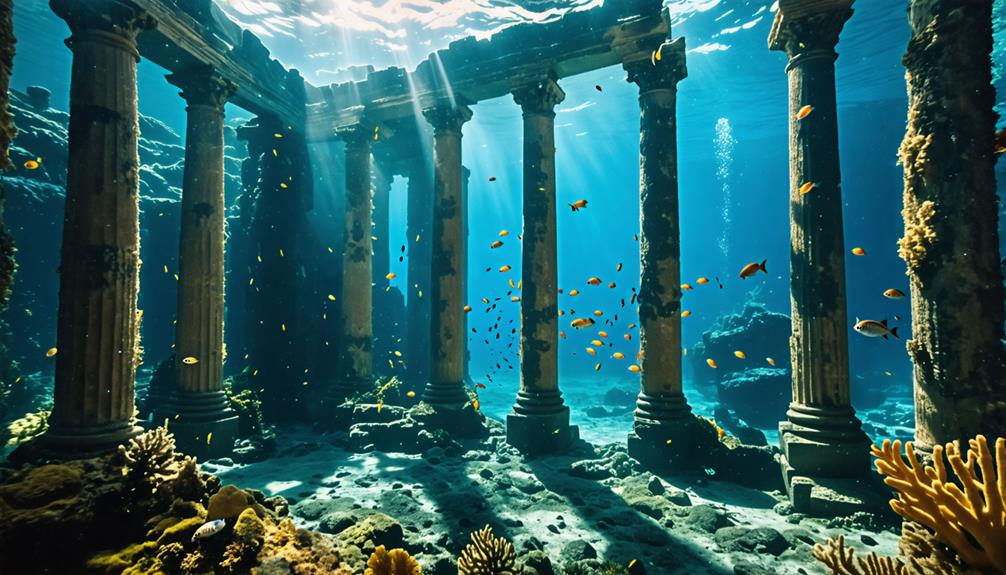
The Lost City of Atlantis: Plato's Sunken City: Fact or Fiction?
You ponder the existence of Atlantis, weighing the possibilities of a lost civilization against the likelihood of a mythical tale. You consider the words of Plato, who described the city's grandeur and its catastrophic downfall, and you wonder if the philosopher's account is rooted in fact or fabricated to illustrate a philosophical point. As you examine the evidence, or lack thereof, you begin to realize that the truth about Atlantis is far more complex than a simple yes or no answer. The mystery remains, and the search for answers is just beginning to unfold.
Key Takeaways
- The Lost City of Atlantis is a mythological place described by Plato as a powerful civilization that existed 9,000 years before his time.
- No concrete evidence supports the existence of Atlantis as a real civilization, and most evidence indicates it is more fiction than fact.
- The scientific community is largely skeptical of Atlantis, viewing it as a myth due to the lack of credible scientific validation.
- Over 130 years of searching have yielded no archaeological evidence to support the existence of Atlantis, contradicting claims of a large landmass sinking.
Origins of the Atlantis Legend

Exploring the roots of the Atlantis legend, you'll find that it all began with the ancient Greek philosopher Plato, who introduced the concept in his dialogues Timaeus and Critias around 360 B.C.

You'll discover that Plato described Atlantis as a powerful, advanced civilization that existed around 9,000 years before his time. According to the myth, this lost island was larger than Libya and Asia combined, boasting impressive technology, wealth, and a complex societal structure.

But, you'll also learn that the story of Atlantis is likely an allegory, meant to illustrate the dangers of imperialism and hubris. Despite the intriguing narrative, there's no concrete evidence to support the existence of Atlantis as a real civilization, leaving you to wonder if it's fact or fiction.

Theories on Atlantis' Location

Numerous theories have emerged about the possible location of Atlantis, with over a dozen proposed sites around the world vying for attention as the lost city's true home. You'll find that some of these sites are based on interpretations of Plato's texts, while others rely on geological evidence.
The Mediterranean Sea is a popular choice, with some researchers suggesting that Atlantis was inspired by the Minoan civilization on the island of Santorini.
The Azores, a group of islands in the Atlantic Ocean, are another proposed location.

Some believe Atlantis lies in the Sahara Desert, which was once flooded.
Tiahuanaco in South America is also a contender.

Underwater locations in the North Sea have also been suggested as the possible remains of the sunken city.
Scientific Perspectives on Existence

The scientific community remains highly skeptical about the existence of Atlantis, with most experts considering it a myth due to the glaring lack of concrete evidence.
You won't find many scientists endorsing the idea that Atlantis was an advanced civilization that actually existed. The lack of credible scientific validation is a major concern.
Geological studies have shown that a large landmass can't just sink into the ocean, which contradicts the narrative of Atlantis' sudden disappearance.
Furthermore, despite over 130 years of searching, no archaeological evidence has been found to support the existence of Atlantis. This leads experts to view Plato's dialogues as a work of fiction rather than a historical account.

As a result, the idea of Atlantis remains firmly in the domain of myth.
Philosophical Themes in Atlantis

You're now entering the domain of philosophical themes in Atlantis, where Plato's narrative masterfully explores the tension between divine and human nature.
As you examine the story, you'll notice how corruption and moral decay ravage the once-virtuous society, raising questions about the inherent flaws in human character.
Divine Vs. Human Nature
Plato's exploration of the struggle between divine and human nature in Atlantis raises profound questions about the delicate balance between virtue and vice, and how easily the latter can corrupt even the most powerful civilizations.
You see, the Atlanteans' downfall serves as a cautionary tale about the dangers of moral corruption and the consequences of unchecked ambition. In Plato's dialogues, Atlantis represents a flawed civilization that ultimately faced divine retribution for its moral decay.
The Atlanteans' loss of virtuous qualities led to their downfall, symbolizing the risks of losing sight of what's truly important.
Societal prosperity can lead to moral decline and eventual destruction, as seen in the case of Atlantis.
The ideal society of Athens is contrasted with the flawed civilization of Atlantis, highlighting the importance of maintaining a balance between virtue and vice.
Unchecked human ambition and arrogance can provoke divine wrath, as evident in the story of Atlantis. This legendary civilization is often seen as a cautionary tale about the consequences of hubris, warning us that excessive pride can lead to one’s downfall. In the context of this narrative, one might reflect on Shakespeare’s grave epitaph meanings, which remind us of the inevitability of fate and the fragility of human achievements in the face of greater forces. Ultimately, these reflections encourage humility and a recognition of our limitations in the grand tapestry of existence.
Divine retribution serves as a reminder of the moral order enforced by the gods in human affairs.
Corruption and Moral Decay
As you consider the downfall of Atlantis, corruption and moral decay emerge as key themes, revealing how the civilization's abandonment of virtue and embrace of vice ultimately sealed its fate. You see how the Atlanteans' insatiable greed and hubris led to their decline, invoking divine punishment. This serves as a cautionary tale, highlighting the importance of moral integrity in societal survival.
| Causes of Downfall | Consequences |
|---|---|
| Corruption and Moral Decay | Societal Downfall |
| Hubris and Greed | Divine Punishment |
| Abandonment of Virtue | Loss of Divine Favor |
Through Atlantis' story, you're reminded that ideal societies prioritize virtue and moral integrity. The city's downfall serves as a stark reminder of the consequences of corruption and moral decay, reinforcing the importance of upholding moral virtues.
Enduring Fascination With Atlantis

While scholars continue to debate the historical accuracy of the Atlantis myth, its enchanting narrative has certainly become an integral part of popular culture, inspiring numerous adaptations and interpretations across various media.
You've probably seen Atlantis featured in films, literature, and art, exploring the idea of lost civilizations and advanced societies. This enduring fascination stems from the myth's ability to resonate with human nature, reflecting societal flaws and the consequences of moral decay.
Some examples of Atlantis' presence in popular culture include:


For over a century, you've been taken on a wild goose chase across the globe, from the depths of the ocean to the scorching hot deserts, in search of the fabled Lost City of Atlantis, but so far, no concrete evidence has been unearthed to prove its existence. Despite numerous searches, the lack of archaeological evidence has led many to question whether Atlantis is fact or fiction. Some proposed sites, such as the Azores and Malta, have been linked to the Atlantis narrative, while others, like the volcanic eruption of Santorini, provide a tantalizing mystery.
| Proposed Site | Description | Evidence |
|---|---|---|
| Azores | Island chain in the Atlantic | Mythological connections |
| Malta | Island nation in the Mediterranean | Ancient structures |
| Santorini | Greek island with volcanic eruption | Cataclysmic event |
| Caribbean | Region with numerous islands | Speculative claims |
Atlantis in Popular Culture

You may not have found concrete evidence of the Lost City of Atlantis in the archaeological record, but it's certainly made a lasting impact on popular culture, inspiring countless works of fiction and speculation. The myth of Atlantis has captivated audiences, often depicting a utopia with advanced technologies.
The Indiana Jones franchise and J.R.R. Tolkien's writings have referenced Atlantis, showcasing its influence on literature and film.
Documentaries and TV shows, such as those on the History Channel, explore the concept of Atlantis, blending historical inquiry with speculative narratives.
Animated series like Disney's 'Atlantis: The Lost Empire' have brought the myth to younger audiences through adventure and fantasy.
The notion of Atlantis has led to conspiracy theories and pseudoarchaeological claims.
Aquaman in comic books and movies demonstrates the myth's influence on popular characters.
Debunking the Atlantis Myth
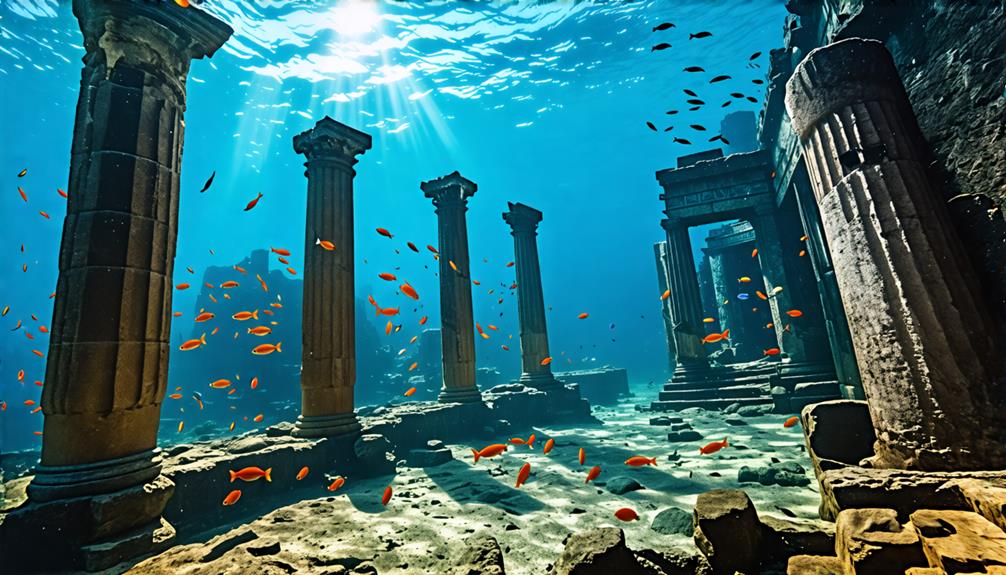
Despite its enduring presence in popular culture, the myth of Atlantis doesn't hold up to scrutiny, with most evidence suggesting that the lost city is more fiction than fact.
You're probably wondering why the Atlantis myth has been debunked by experts. The answer lies in the lack of historical evidence and credible archaeological findings.
While ancient Greek philosopher Plato wrote about Atlantis in his dialogues Timaeus and Critias, there's no independent evidence supporting its existence outside of his writings.
Additionally, geological studies contradict the phenomenon of a large landmass sinking, as described in the myth.
It's clear that Atlantis is largely a fictional construct, and ongoing exploration has failed to uncover any concrete evidence to prove otherwise.
Debunking the Atlantis myth reveals that it's more legend than reality.
Uncovering the Truth About Atlantis

Uncovering the truth about Atlantis requires a closer examination of the facts and interpretations that have shaped our understanding of this enigmatic myth.
You're about to explore the heart of the mystery, investigating what Plato described as a powerful and advanced civilization.
As you investigate, consider the following:
- The myth of Atlantis has been interpreted as a philosophical allegory, warning against moral decay and hubris.
- Despite extensive searching, no credible archaeological evidence has been found to support the existence of Atlantis.
- Some scholars link Atlantis to real civilizations, while others dismiss it as fiction.
- Geological studies suggest natural disasters may have inspired the narrative.


