About 1 Million Earths Could Fit Inside the Sun
Have you ever paused to reflect on the sheer enormity of our Sun? It's a celestial giant that dwarfs our planet in every conceivable way. When you hear that about one million Earths could fit inside the Sun, it's not just a neat factoid—it's a doorway to understanding the vast scale of our solar system. This mind-boggling comparison sets the stage for exploring how the Sun's immense size influences everything from planetary orbits to the very conditions that make life on Earth possible. But the Sun's size is just the beginning of its fascinating story.
Key Takeaways
- The Sun's volume is approximately 1.3 million times that of Earth, theoretically allowing 1 million Earths to fit inside.
- Realistic simulations adjust the estimate to about 932,884 Earths fitting within the Sun due to packing density considerations.
- The Sun's radius is 109 times that of Earth, measuring over 695,000 km in diameter.
- The Sun's volume is 1.412 x 10^18 km³, vastly surpassing Earth's 1.083 x 10^12 km³.
The Sun's Colossal Size
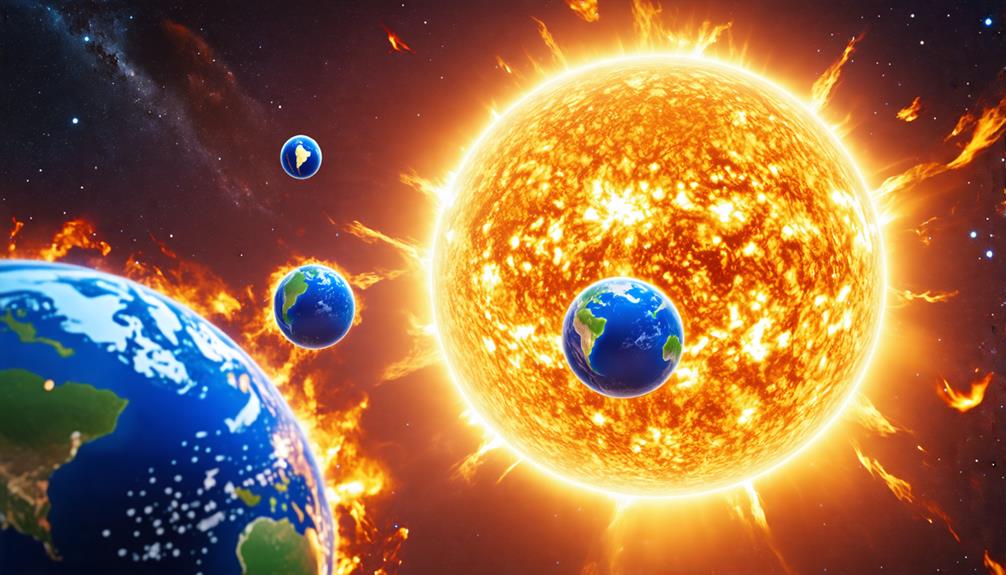
When it comes to size, the Sun is truly in a league of its own, dwarfing Earth and dominating our solar system. You might be surprised to learn that the Sun's radius is a staggering 109 times that of Earth, stretching over 695,000 km.

Its colossal size becomes even more apparent when you consider its volume, which could theoretically contain about 1.3 million Earths if they were perfectly packed inside. However, more realistic calculations suggest that around 932,884 Earths could actually fit within the Sun's boundaries.

To put its massive scale into perspective, the Sun’s surface area is approximately 12,000 times that of Earth. This celestial giant comprises 99. 86% of our solar system’s total mass, weighing about 333,000 times more than our planet. The Sun’s immense size truly boggles the mind. Its gravitational pull governs the orbits of all the planets, including Earth, creating a delicate balance that sustains life. Interestingly, beneath its fiery exterior lies an intriguing comparison: the largest volcano in the solar system, Olympus Mons on Mars, measures approximately 13. 6 miles in height, dwarfing any terrestrial volcano. While the Sun serves as a constant source of energy and heat for our planet, Olympus Mons stands as a testament to the geological wonders that other worlds hold in our vast solar neighborhood.

Earth Vs Sun Comparison
You'll find the differences between Earth and the Sun staggering when you compare their key characteristics.
The Sun, the largest object in our solar system, dwarfs our planet in every measurable aspect. Its volume is a whopping 1.412 x 10^18 km³, while Earth's is just 1.083 x 10^12 km³. This vast difference means that about 1.3 million Earths could fit inside the Sun based on volume calculations. However, more realistic simulations suggest a lower number of 932,884 Earths could fit inside, accounting for packing density.
The Sun's diameter is 109 times that of Earth, measuring 1,392,000 km compared to Earth's 12,742 km. Perhaps most impressively, the Sun's mass is approximately 333,000 times that of Earth, highlighting its immense gravitational influence on our solar system.

Implications for Solar System Dynamics

The Sun's massive size and gravitational dominance profoundly shape the dynamics of our entire Solar System.
With 99.86% of the Solar System's mass, the Sun's immense gravity keeps planets in stable orbits, including Earth at an average distance of 150 million km.

While about 932,884 Earths can fit in the Sun, not 1.3 million as commonly believed, this size difference still emphasizes the Sun's vital role in planetary motion and Solar System dynamics.
Understanding the Sun's size and gravitational influence helps you grasp:
- How planets maintain their elliptical orbits
- The Sun's impact on climate patterns
- Its role in sustaining life on Earth
The Sun's dominance extends beyond its physical size, affecting everything from orbital mechanics to Earth's climate, underscoring its importance in our cosmic neighborhood.
Conclusion
You've seen how the Sun dwarfs our planet, with room for about a million Earths inside.
This vast size difference isn't just a fun fact; it's essential to understanding our solar system. It's why planets orbit the Sun and not vice versa.

As you ponder the Sun's immensity, remember it's not just big—it's the powerhouse that keeps Earth alive, influencing everything from our climate to our very existence.